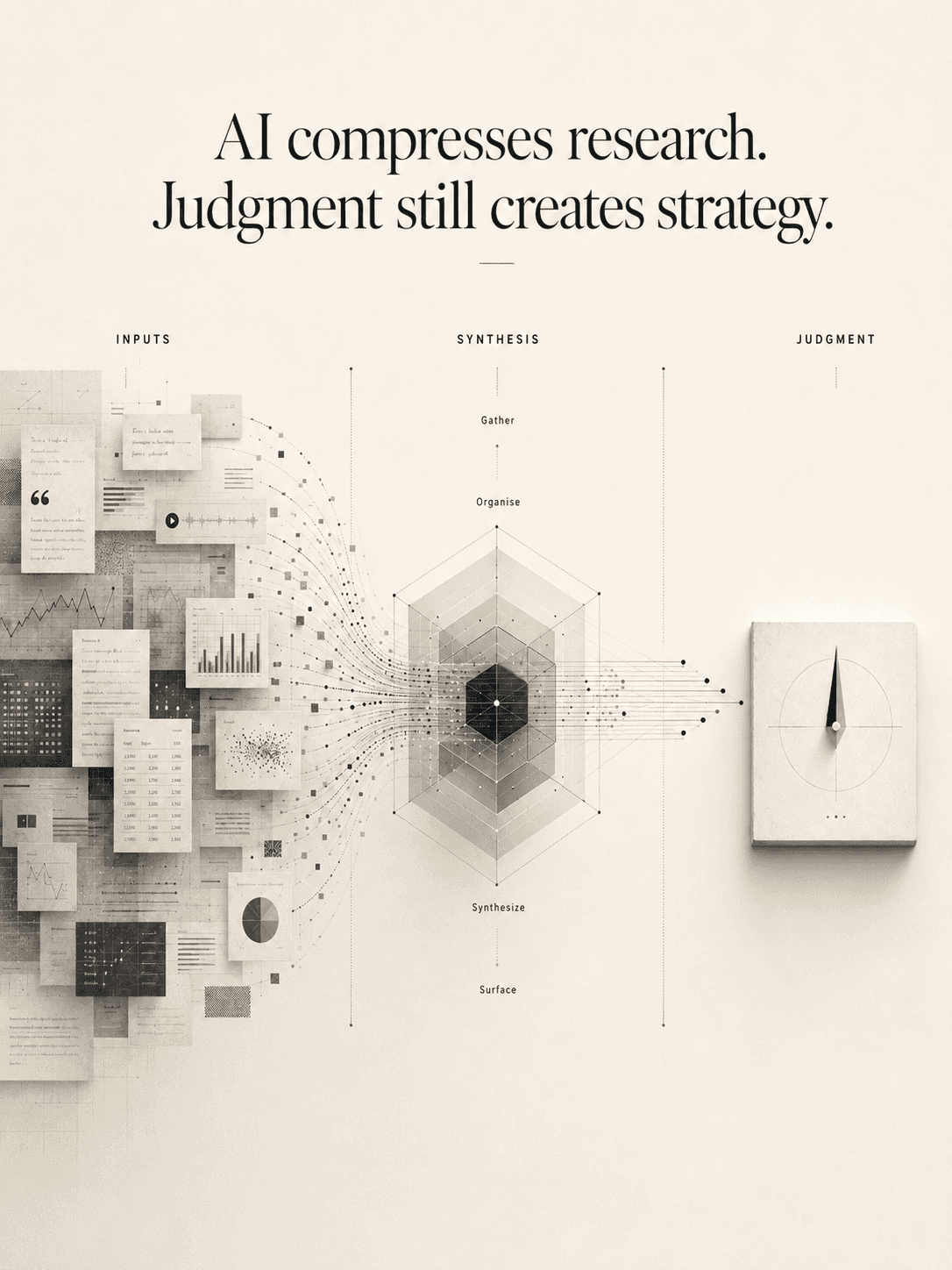

AI can tell you what is in the data. It cannot tell you what the data is not capturing.
There is a question that has been keeping executives awake. If a junior analyst using AI can produce the same research output as a senior strategist, what exactly are organisations paying for? It is not hyperbole. It is the central disruption that AI has introduced to knowledge work, and the research process sits at the heart of it.
The answer matters especially for strategy. Research is not a preliminary step that precedes thinking. It is the thinking. How information is gathered, what gets synthesised, and which insights are surfaced for decision-making are not administrative functions, they are the architecture of strategic judgment. AI is changing all three. The question is whether that change improves decisions or merely accelerates them.
What has actually changed
The scale of adoption makes the shift undeniable. The Stanford Human-Centered AI Institute's 2025 AI Index Report documents that 78% of organisations reported using AI in at least one business function in 2024, up from 55% the year before, the steepest single-year increase on record (Maslej et al., 2025). Within knowledge work specifically, the shift is from AI as a search tool to AI as a synthesis engine. McKinsey's 2025 workplace report documents the emergence of reasoning-capable models that move beyond information retrieval to nuanced understanding: able to generate step-by-step analytical plans and surface patterns across large bodies of material (McKinsey & Company, 2025).
For the research process, this means two things practically. Literature reviews that previously took days now take hours. Data synthesis across multiple sources: competitor intelligence, market signals, user research transcripts can be compressed into structured outputs in minutes. Research from Berkeley's CHI 2025 conference confirms the pattern: AI tools shift worker effort from implementation to supervision, reducing time spent on gathering and organising information and increasing time spent evaluating and directing outputs (Yun et al., 2025).
The part that does not change
Speed of synthesis is not the same thing as quality of judgment. This is the distinction that research on AI and strategic decision-making consistently returns to. A 2024 academic study by researchers at the University of Michigan, UT Austin, and INSEAD studied entrepreneurs and investors using AI for strategy generation and evaluation. The finding was precise: AI improved the breadth of strategic options considered, but humans remained significantly better at evaluating which options were actually worth pursuing (Csaszar et al., 2024). More options on the table is not the same as better decisions at the table.
The Harvard Business School's jagged frontier study reinforces the limit. AI performs reliably up to a threshold: synthesis, pattern recognition, option generation and then fails unpredictably on tasks requiring original judgment, novel framing, and the ability to identify questions that have not yet been asked (Dell'Acqua et al., 2023). For research-led strategy, this is the critical boundary. AI can tell you what is in the data. It cannot tell you what the data is not capturing.
MIT Sloan Management Review frames this precisely. When knowledge becomes commoditised – when any analyst with access to AI can surface the same information, the value of expertise shifts from content to context (Kalluri, 2025). The most valuable research capability is no longer finding answers. It is knowing which questions are worth asking, and recognising the assumptions embedded in the ones being asked.
Why this matters for strategy
Research-led strategy has always been about more than information gathering. The value is in the interpretation: the ability to look at the same data as everyone else and see something different. AI accelerates the front end of that process significantly. It does not change what happens at the back end.
What it does change is the cost of getting to insight. Teams that previously could not afford the time to conduct thorough competitive research, synthesise customer data, or review industry literature now can. MIT Sloan Management Review's 2025 data science trends report notes that 92% of organisations identify cultural and change management challenges, not technology, as the primary barrier to becoming genuinely research-led (MIT Sloan Management Review, 2025). The tools are not the bottleneck. The willingness to build research into strategic decisions before they are made is.
That is the shift AI enables but does not guarantee. Faster synthesis clears space for more deliberate interpretation. Whether organisations use that space for judgment or simply move faster toward the same conclusions they would have reached anyway is the real strategic question.

Let’s keep in touch.
Discover more about high-performance web design. Follow us on Twitter and Instagram.