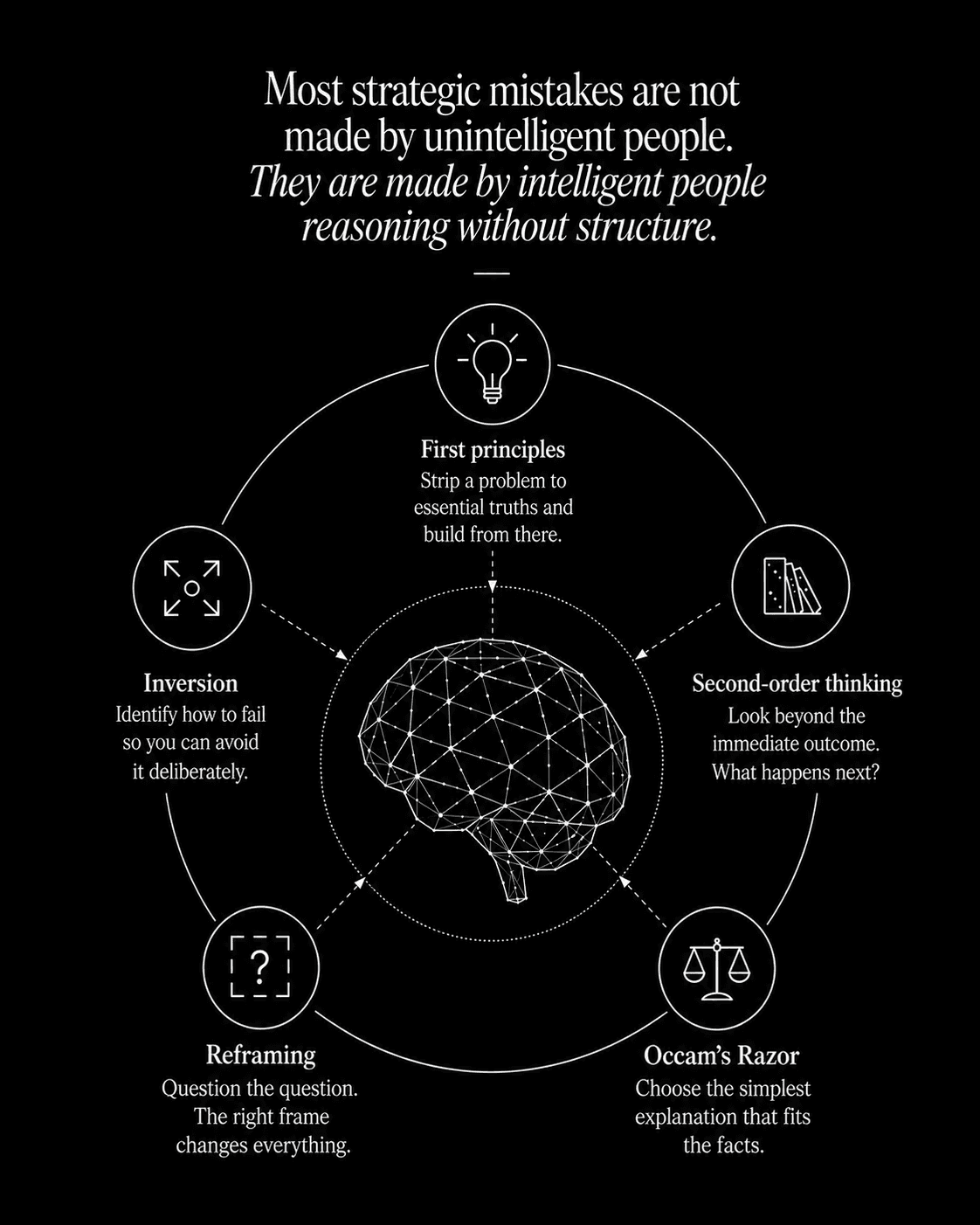

Mental models are not thinking tools. They are corrections for predictable human error.
Most strategic mistakes are not made by unintelligent people. They are made by intelligent people reasoning without structure. In 1974, Amos Tversky and Daniel Kahneman demonstrated that human judgment predictably deviates from rational choice through cognitive shortcuts that produce reliable, repeatable errors (Tversky & Kahneman, 1974). Their work, awarded the Nobel Prize in Economics in 2002, established the foundational case for structured thinking frameworks — not as intellectual exercises, but as correctives to documented cognitive failure modes.
Charlie Munger, the late vice chairman of Berkshire Hathaway, spent decades building what he called a latticework of mental models — a cross-disciplinary toolkit for decision-making that he argued was more reliable than any single framework or domain of expertise (Munger, 2005). The frameworks below are drawn from both traditions: the academic research that explains why human judgment fails, and the practitioner literature that has applied systematic corrections to those failures across decades of high-stakes decision-making.
First principles thinking
Tversky and Kahneman's representativeness heuristic describes the human tendency to judge new situations by their resemblance to familiar categories — solving new problems by analogy to old ones. This works until the new problem is genuinely unlike its apparent precedents, at which point it produces systematic error (Tversky & Kahneman, 1974).
First principles thinking is the deliberate interruption of analogical reasoning. It strips a problem to its verifiable foundations — what is actually true, independent of convention — and builds from there. Munger applied this explicitly to investment analysis, rejecting market consensus as a starting point in favour of independent assessment of underlying business economics (Munger, 2005). For a founder, the application is direct: before benchmarking against competitors or industry norms, ask what is demonstrably true about your customer, your cost structure, and your product's actual value.
Inversion
Kahneman and Tversky's prospect theory established that humans weight losses approximately twice as heavily as equivalent gains relative to a reference point (Kahneman & Tversky, 1979). This asymmetry means the brain evaluates failure scenarios with greater accuracy and attention than success scenarios.
Munger formalised this as inversion — crediting the mathematician Carl Jacobi's instruction to "invert, always invert" — arguing that asking what would guarantee failure is often more productive than asking what would produce success (Munger, 2005). The logic is grounded in cognitive science: a mind that over-weights losses will map the failure landscape more thoroughly than the success landscape. Inversion is a deliberate strategy for exploiting that asymmetry. A product launch plan that has survived a rigorous failure analysis is more robust than one that has not, because it has engaged the cognitive faculty most reliably accurate at identifying threats.
Second-order thinking
Howard Marks, co-founder of Oaktree Capital Management, framed second-order thinking as the distinction between thinking that everyone does and thinking that goes further: not just "what will happen" but "what will happen next, and what will happen after that" (Marks, 2011). The practitioner framing is precise and accessible.
The academic evidence supports why this matters. A 2025 review by researchers at LSE, King's College London, and Bayes Business School identified failure to model downstream consequences as one of the most persistent and costly biases in organisational decision-making, and found that structured training in consequence-mapping produced significantly better decision quality (Fasolo et al., 2025). Second-order thinking is that training applied as a habit: before any decision, extend the consequence horizon beyond the immediate effect.
Occam's Razor
A preregistered behavioural study by researchers from SISSA, the University of Pennsylvania, Harvard, Oxford, and the Santa Fe Institute found that humans naturally prefer simpler explanations for uncertain data — and that these preferences align with formal statistical theories that penalise excessive complexity in models (Piasini et al., 2025). Parsimony is not just philosophically appealing. It appears to reflect how sound inference actually works.
In practice: when a business problem presents itself, the simplest explanation consistent with available evidence is the most likely starting point. Complex multi-causal narratives require more evidence to justify and produce less actionable conclusions. Occam's Razor does not prohibit complex explanations. It requires that complexity be earned by the evidence.
Reframing the question
McKinsey's research on the framing effect documented a case in which an e-commerce retailer optimised promotions to address declining average order value for months — only to discover the real problem was eroding trust in product quality (McKinsey & Company, 2025). The analytical work was rigorous. The question was wrong.
Reframing — deliberately interrogating whether the question being asked is the right one — sits above all other frameworks. Munger described this as one of the most valuable intellectual habits: refusing to accept the frame as given (Munger, 2005). First principles, inversion, and second-order thinking produce better answers. Reframing determines whether the right question is being answered in the first place.
Why structure matters before the decision
Research by Fasolo et al. (2025) found that debiasing interventions are significantly more effective when applied before decisions are made rather than as corrections after the fact. Mental models are most valuable as pre-decision disciplines, not post-hoc rationalisations. The frameworks above are not a checklist. Used consistently, they are an operating system for judgment under uncertainty — which is precisely the condition in which founders spend most of their time.
Let’s keep in touch.
Discover more about high-performance web design. Follow us on Twitter and Instagram.