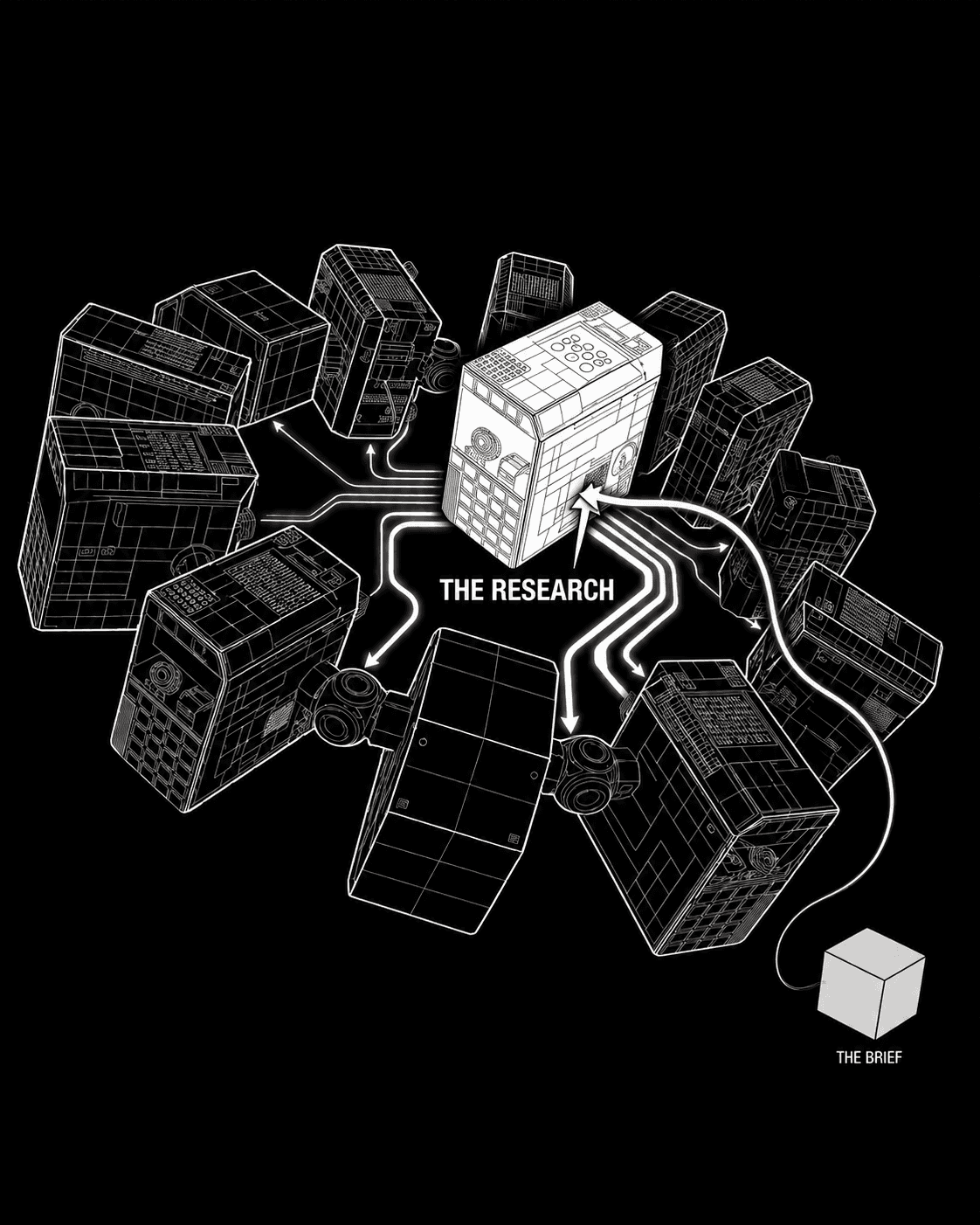

Being wrong early, in a conversation, costs nothing. Being wrong late, in a shipped product, costs everything already spent getting there.
The founders of failed startups rarely realise their mistake at the moment they made it. CB Insights' analysis of 431 VC-backed companies that shut down since 2023 found poor product-market fit cited in 43% of failures — the single largest cause (CB Insights, 2026). Running out of capital affected 70% of the same failures, but CB Insights is explicit: this is the final symptom, not the root cause. The capital ran out because it was spent building something the market did not want.
This is not information that becomes available after launch. It is available before a single line of code is written. Most founders skip finding it out anyway.
What research-led building actually looks like
Steve Blank, the Silicon Valley veteran whose Customer Development methodology underpins the modern lean startup movement, built his framework on one premise: the facts reside outside the building. Not in planning meetings. Not in internal debate about what customers probably want. Blank's Four Steps — Customer Discovery, Customer Validation, Customer Creation, Company Building — require founders to test their hypotheses directly against real customers before committing resources to building (Blank, 2013). His methodology assumes multiple rounds of being wrong. That is the point. Being wrong early, in a conversation, costs nothing. Being wrong late, in a shipped product, costs everything already spent getting there.
A parallel discipline, Jobs to Be Done theory, asks a sharper question: not what does the customer want, but what job the customer is hiring this product to do. Clayton Christensen's now-famous case study involved a fast-food chain that spent months trying to improve milkshake sales through demographic research and taste testing, with no results — until interviews revealed the actual job: commuters wanted something that made a boring drive more bearable and kept them full until lunch (Christensen et al., 2016). None of the metrics the company had been optimising were the ones that mattered.
The same research uncovered a subtler case. A Detroit homebuilder could not understand why downsizing retirees toured units enthusiastically but didn't buy. The company had been adding granite countertops and bay windows in response to focus groups. It was not until Bob Moesta interviewed actual buyers that the real obstacle surfaced: what to do with the dining room table. The table represented family history, and the anxiety of deciding its fate was what stalled the decision to move. Once this was understood, the company redesigned units around larger dining spaces and added moving and storage services — solving the actual job, not the assumed one (Christensen et al., 2016).
Both cases share a structure. The team had already built something. The research corrected a nearly fatal misread — after the cost of that misread had been paid.
The financial case for testing before building
Rita McGrath and Ian MacMillan, writing in the Harvard Business Review, made the sharpest version of this argument in a framework called discovery-driven planning. Conventional planning judges a plan by how closely results match projections. In a genuinely uncertain venture, McGrath and MacMillan argue this is the wrong test entirely — the real discipline is identifying which assumptions the plan depends on, and staging capital release against evidence that those assumptions hold (McGrath & MacMillan, 1995/2017). Fund the next milestone only once the previous one has been tested. Track the assumptions explicitly rather than letting them go unquestioned. McGrath's later research into failed growth projects found the same pattern recurring: assumptions that were never tested, capital committed too far in advance, and no built-in checkpoint to redirect once new information appeared.
This reframes what research actually is. It is not a delay before building. It is a mechanism for releasing capital only against proof — the financial version of learning before spending.
The arithmetic founders skip
Two months of structured customer interviews cost founder time and a willingness to be wrong. A shipped product built on an untested assumption costs engineering time, a sales team's payroll, and marketing spend against a market that was never there — and per CB Insights, there is a 43% chance the entire effort was misdirected from the start.
This is not a close call. Discovery-driven planning does not eliminate risk. It relocates the moment risk gets tested from after the money is spent to before.
Why Qoyn begins here
Every engagement at Qoyn opens with the same question, asked before strategy or design: what job is this actually being hired to solve, and does the evidence support it. We are not interested in confirming what a founder already believes. We are interested in what breaks that belief before it becomes an expensive one. The research phase is not overhead. It is the cheapest insurance a founder will ever buy against building the wrong thing well.
Let’s keep in touch.
Discover more about high-performance web design. Follow us on Twitter and Instagram.