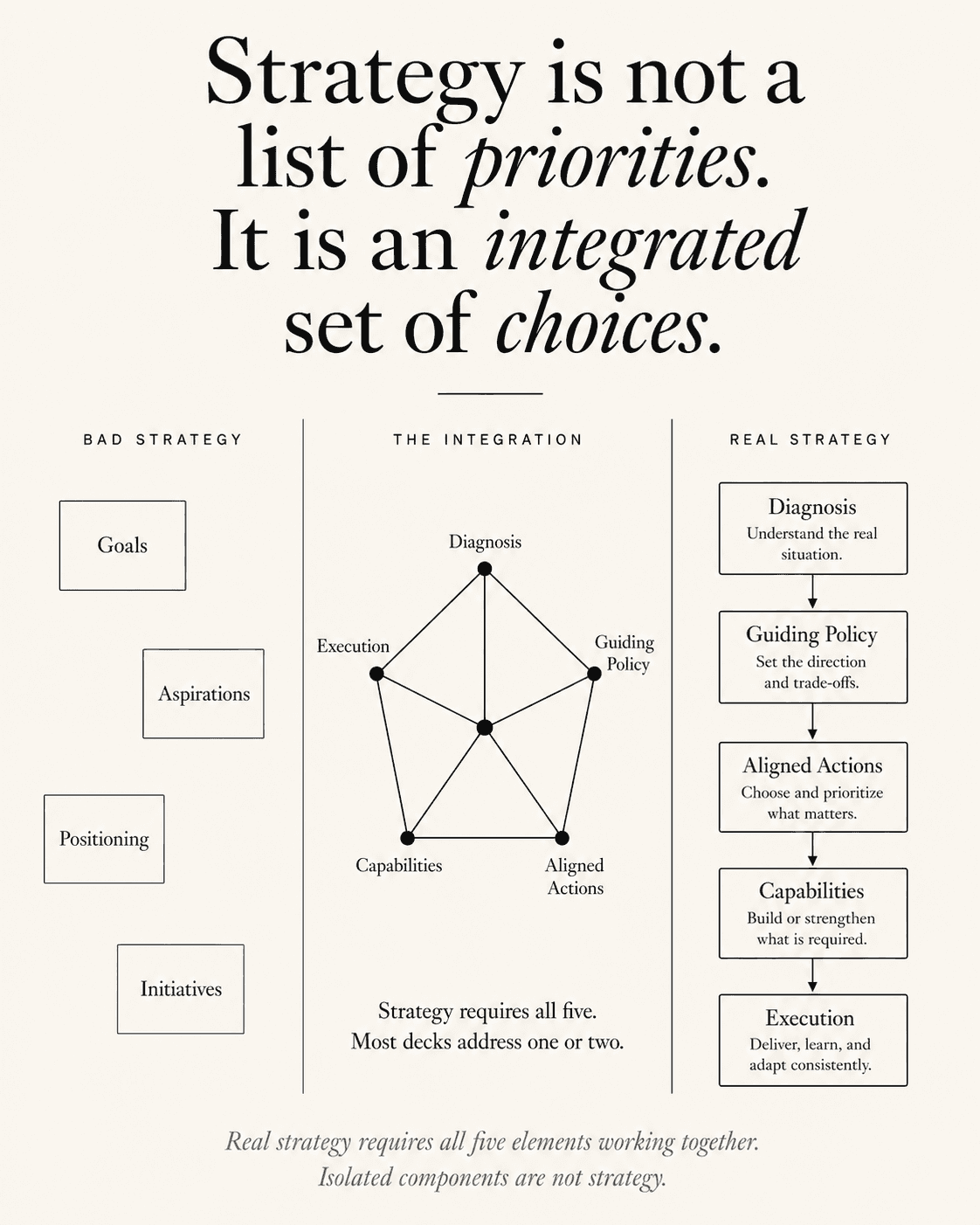

A strategy that does not name its central challenge is not a strategy. It is a wishlist.
Strategy is the most overused word in business and the least precise. It is also the easiest to fake. A founder who has built nothing real can still produce a deck called "Strategy" — pages of confident statements, ambitious targets, and language borrowed from consulting reports. The deck looks like strategy. It is read as strategy. It functions internally as strategy. None of it is strategy.
This is not a stylistic complaint. McKinsey's 2025 research found that only 21% of senior executives say their strategies pass four or more of the Ten Tests of Strategy — a 40% drop from a decade and a half earlier (McKinsey & Company, 2025). The condition is now structural. Most documents called strategy are something else. The question worth asking is what.
What strategy actually is
Four frameworks, developed independently across three decades, agree on the essential structure.
Michael Porter, writing in the Harvard Business Review in 1996, defined strategy as the deliberate choice of a different set of activities to deliver a unique value proposition. Strategy, in Porter's framing, is not operational effectiveness. Being better than competitors at the same activities everyone else performs is not strategy — that is execution. Strategy requires different activities, and the trade-offs that come from choosing what not to do. IKEA does not make better furniture than Herman Miller. It makes different furniture, in a different way, for a different customer, with a different cost structure. That set of choices is strategy. Operational improvement on top of those choices is not (Porter, 1996).
Donald Hambrick and James Fredrickson, in a 2001 peer-reviewed paper in the Academy of Management Executive, argued that any real strategy must answer five specific questions: where will we be active (arenas), how will we get there (vehicles), how will we win (differentiators), what is the speed and sequence (staging), and how will we obtain returns (economic logic). Most strategic plans address one or two of these and treat the rest as implementation. The result is not an incomplete strategy. It is not a strategy at all (Hambrick & Fredrickson, 2001).
Richard Rumelt, professor at UCLA Anderson, formalised the same logic into what he calls the kernel of good strategy: a diagnosis of the central challenge, a guiding policy for addressing it, and a set of coherent actions that follow. Without all three, what you have is not strategy. It is one of the components disguised as the whole (Rumelt, 2011).
A.G. Lafley and Roger Martin, in Playing to Win (2013), arrived at the same conclusion through a different route. Strategy is an integrated set of five choices: winning aspiration, where to play, how to win, required capabilities, and management systems. The framework's most useful insight is what it rules out: keeping options open is not strategy. Strategy is the act of making choices that close off other options (Lafley & Martin, 2013).
The four frameworks use different vocabulary. They describe the same thing.
What founders mistake for strategy
Rumelt identifies four common failure modes (Rumelt, 2011). The reader will recognise all of them.
Goals dressed as strategy. "Become the leading platform in our category by 2027." This is a goal. It tells you nothing about how you will get there, what trade-offs you will make, or what makes the path defensible. Goal-setting is not strategy. It is the thing strategy is supposed to enable.
Aspirations dressed as strategy. "We will redefine how mid-market companies experience financial reporting." This is an aspiration — a statement about identity, not action. It does not name a challenge to be overcome or a guiding policy for overcoming it. It is the company describing how it would like to be perceived.
Fluff. "Leveraging our proprietary data infrastructure to deliver scalable, AI-native solutions across the customer journey." This is the kind of sentence that survives because no one in the room is willing to admit they cannot decode it. Fluff is jargon used as a substitute for clarity. It is the linguistic symptom of strategic absence.
Failure to face the challenge. Most founder strategy documents are silent on the actual obstacle the business is trying to overcome. They list opportunities, target outcomes, and market sizes. They do not name what is genuinely difficult about the path forward. A strategy that does not name its central challenge is not a strategy — it is a wishlist (Rumelt, 2011).
The most useful diagnostic test is the one Kaplan and Norton documented at Harvard Business School: in most companies, only 5% of employees can clearly articulate their organisation's strategy (Kaplan & Norton, 2001). If 95% of the people inside the company cannot state the strategy, the strategy does not exist as a working document. It exists only as language on a slide.
The deck audit
This converts directly into a test the reader can run today. Open the document called strategy. Then ask four questions.
What is the central challenge the business is trying to overcome — named explicitly?
What set of activities will the business do differently from competitors — and what activities will it deliberately not do?
Where will the business compete, how will it win there, and what specific capabilities make that winning possible?
What are the coherent actions that follow from these choices — and which option does each action close off?
If the document does not answer all four, it is not a strategy. It is one or more of the things founders mistake for strategy. This is not a semantic issue. Companies that survive build their strategic frameworks deliberately. Companies that fail mistake confident language for thinking. The difference, repeated across hundreds of decisions, is the difference between businesses that compound advantages and businesses that look impressive in the room.
Let’s keep in touch.
Discover more about high-performance web design. Follow us on Twitter and Instagram.