
A logo is not a brand. A website is not a brand. A brand is the system that ensures every artefact reinforces the same recognition pattern in the customer's memory.
Founders are systematically rational about most things and systematically irrational about one. They will model unit economics to three decimal places, run sensitivity analyses on CAC payback periods, and rebuild financial forecasts every quarter, and then approve a deck, a website page, and a sales one-pager that visually contradict each other because each was produced under time pressure by a different person. The decisions feel small. The cost is not.
Brand consistency is treated as an aesthetic concern. It is an asset class. And like any asset class, it compounds when invested early and depreciates when neglected — except the depreciation does not appear on any financial statement, which is precisely why it is the easiest thing for an early-stage company to underinvest in without noticing.
What consistency does to the brain
The research on why consistency matters is not marketing literature. It is cognitive psychology. A foundational peer-reviewed paper in the Journal of Marketing Research established that repeated, consistent exposure to a brand increases what researchers call processing fluency — the ease with which the brain recognises and processes a stimulus — and that this fluency directly produces more favourable attitudes toward the brand (Lee & Labroo, 2004). The mechanism is automatic. The brain prefers what it can process easily. Consistent visual, verbal, and experiential cues make a brand easier to process. Easier processing produces preference. Preference produces purchase. The chain is not subjective.
A 2024 study in Psychology & Marketing quantified the threshold precisely. Across three controlled studies, researchers found that perceived brand familiarity — the foundation of self-brand connection, which drives loyalty and willingness to pay — formed measurably after as few as four consistent exposures to a logo (DelVecchio et al., 2024). The implication for an early-stage company is direct. The first four touchpoints a customer encounters are not casual impressions. They are the period during which the brain decides whether your brand is something it recognises or something it has to evaluate from scratch every time. Inconsistency across those touchpoints does not slow that process down. It restarts it.
What consistency means across touchpoints
A common misconception is that consistency means using the same logo. It is much broader. McKinsey's research on customer experience found that managing isolated touchpoints rather than the entire journey is the single largest source of inconsistency — and that consistent, clear communication across the full journey is one of the most important predictors of customer experience quality (McKinsey & Company). Every touchpoint where the customer encounters the company is part of the brand: the website, the pitch deck, the contract document, the sales email signature, the LinkedIn page, the customer support reply, the invoice. Most early-stage companies have visual and verbal coherence across two or three of these. Almost none have it across all of them.
This is where small teams systematically cut corners. The website gets professional design. The pitch deck is built in a hurry the night before the meeting. The contract is a template from a previous job. The invoice is whatever the accounting software defaults to. Each individual decision is rational under time pressure. The aggregate is a brand that contradicts itself every time a customer moves between channels — which is exactly the customer journey McKinsey's research identifies as the most fragile point in the experience.
Why it compounds — and why founders quit too early
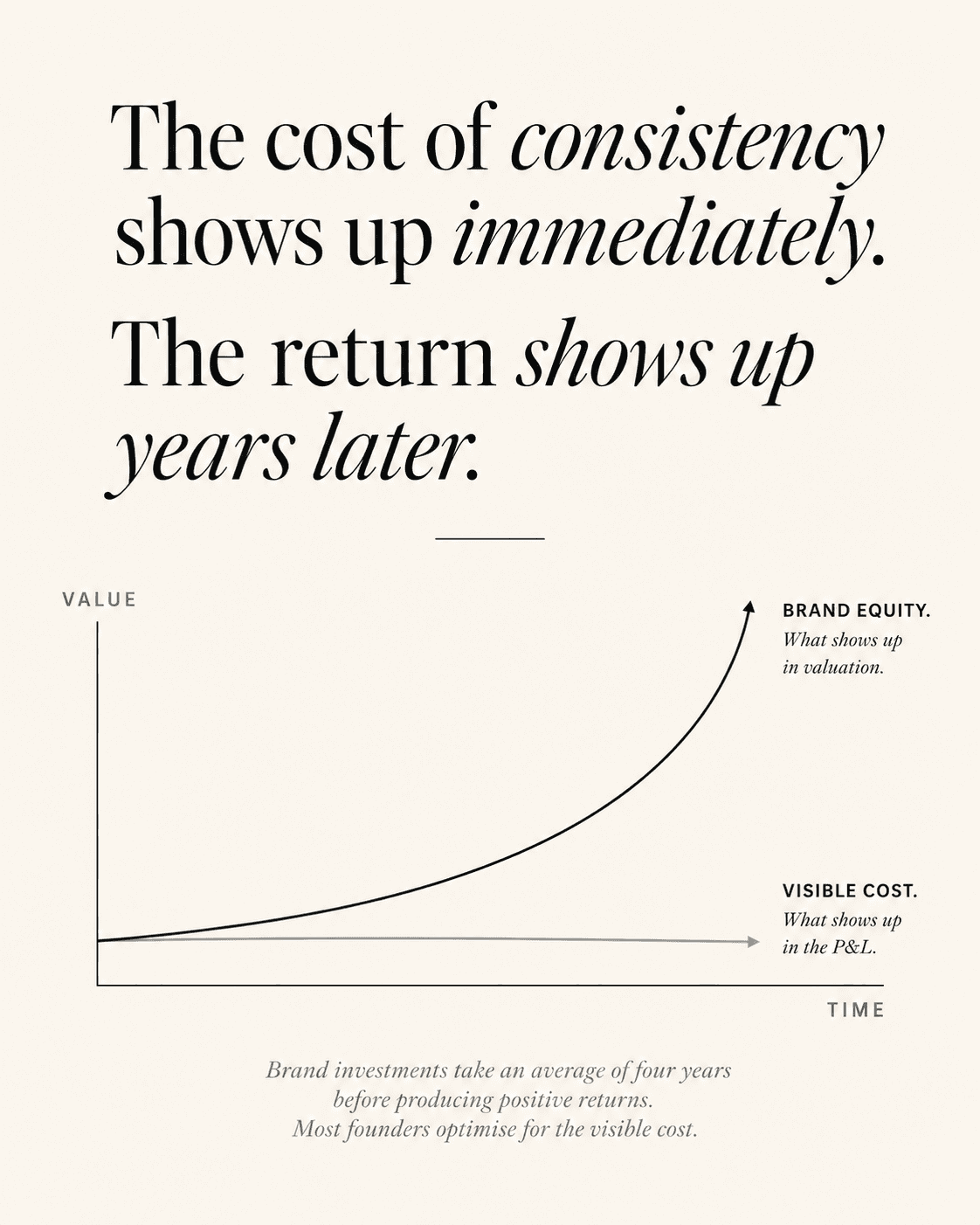
The compounding case is where the economics become impossible to ignore. A peer-reviewed study modelling brand equity as a stock built from up to 30 years of past investment found that brand investments take on average four years before producing positive financial returns, peak in impact after 11 years, and contribute €265,000 to annual profit for the median trademarking firm (Bagna et al., 2019). The four-year lag is the critical number for founders. Most early-stage companies do not survive long enough to see brand investment pay back — but the ones that do see disproportionate returns from the discipline of having maintained consistency through the unprofitable years.
The financial argument is even more direct. A 2022 study found that brand capital contributes between 10% and 23% of firm value on average across companies — and up to 60% of firm value for consumer-facing companies (Boustanifar & Kang, 2022). Brand investments are expensed immediately under standard accounting rules rather than capitalised as an asset, which means they are systematically undervalued on the balance sheet despite building substantial long-term value. For a founder, this is the underinvestment trap. The cost of consistency shows up immediately in the P&L. The return shows up years later in valuation. Most founders optimise for the visible cost.
The trust layer
Edelman's 2025 Trust Barometer found that consumers now trust brands more than they trust institutions — and that 73% of consumers say their trust in a brand increases when it authentically reflects culture and engages consistently with their world (Edelman, 2025). Trust is the precursor to purchase, loyalty, and advocacy. It is also the most fragile asset a brand owns. Inconsistency does not just slow trust formation. It actively damages it, because the brain interprets inconsistency as unreliability — a brand that cannot maintain coherence in how it presents itself signals that it cannot be relied on to be coherent in delivery.
Systems, not assets
The decision a founder actually faces is not whether to invest in design. It is whether to treat brand as a series of one-off deliverables or as a system. A logo is not a brand. A website is not a brand. A pitch deck is not a brand. A brand is the system that ensures every one of those artefacts — and every future artefact the company will produce — reinforces the same recognition pattern in the customer's memory. One-off assets cannot do this. Only systems can.
The compounding returns documented in the research are not available to companies that produce assets when they need them. They are available only to companies that build the systems that produce assets consistently. The first kind of investment costs less in the short term. The second kind is the only one that pays back.
Let’s keep in touch.
Discover more about high-performance web design. Follow us on Twitter and Instagram.